
Digestive blockages in small pets are serious and often life-threatening. They can result from swallowing foreign objects, structural issues like tumors, or conditions such as intussusception. Recognizing the symptoms early and acting quickly can save your pet’s life – and your wallet.
Key Takeaways:
- Foreign objects (like toys, socks, or string) are the most common cause of blockages.
- Symptoms include vomiting, lethargy, abdominal pain, and refusal to eat.
- Costs for treatment range from $800 to $8,000 depending on severity.
- Prevention: Keep hazardous items out of reach, supervise pets, and follow regular deworming schedules.
Quick Stat: Pets treated early for blockages have a survival rate of around 96%.
Act fast if you notice symptoms. Delays can lead to severe complications like tissue death or infections, requiring costly surgeries. Prevention is your best defense – keep your home safe and visit your vet regularly.
Intestinal OBSTRUCTION in DOGS 🐶👨⚕️(Symptoms and Treatment)
sbb-itb-e212914
Foreign Body Ingestion: The Most Common Cause
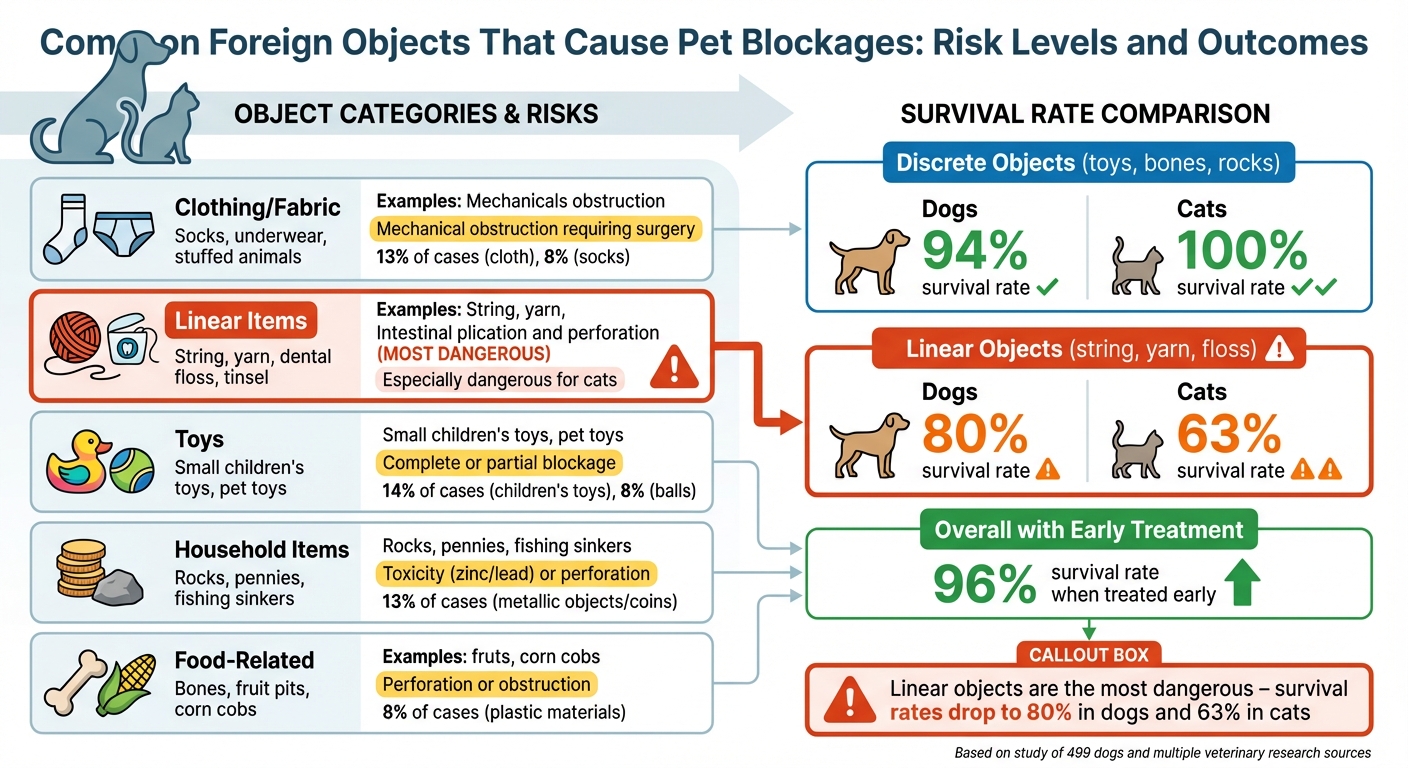
Common Foreign Objects That Cause Pet Blockages: Risk Levels and Outcomes
Foreign body ingestion is the top reason for digestive blockages in small pets. Pets often swallow non-food items out of curiosity, during play, or due to a condition called pica. Some appetite-enhancing medications can also lead to indiscriminate eating. Understanding the types of objects pets ingest helps explain how these items affect their digestive systems.
Ingested objects generally fall into two categories: discrete (like toys or bones) and linear (such as yarn or dental floss). Linear objects are especially dangerous because they can anchor in places like the stomach or under the tongue. As the intestines try to move the object, it can cause folding (plication) and even perforation. One study involving 499 dogs found that linear foreign bodies caused more intestinal damage, including necrosis and perforation, compared to discrete items. However, both groups had a high survival rate of 96% after treatment.
"Cats in particular enjoy eating linear objects such as string, yarn, rope, tape, and Christmas tinsel." – Horizon Veterinary Services
Objects That Frequently Cause Obstructions
Certain items are more likely to cause blockages, and understanding these risks can help prevent serious health issues. A study of 72 dogs revealed a wide range of ingested objects: 14% swallowed children’s toys, 13% consumed metallic objects or coins, 13% ingested cloth, and 8% each ate socks, balls, or plastic materials. Clothing items, like socks and underwear, are particularly tempting because they carry the scent of their owner, making them irresistible to curious pets.
Linear objects are especially hazardous. Cats often play with and swallow items like string, yarn, dental floss, tinsel, or tape. Dogs, on the other hand, ingest a variety of objects, including rocks, bones, corn cobs, and fruit pits. Some objects have additional dangers. For example, pennies made after 1982 contain zinc, which can cause fatal poisoning if not removed quickly. Similarly, fishing sinkers or drapery weights may contain lead, posing another serious health risk.
| Object Category | Common Examples | Risk |
|---|---|---|
| Clothing/Fabric | Socks, underwear, stuffed animals | Mechanical obstruction requiring surgery |
| Linear Items | String, yarn, dental floss, tinsel | Intestinal plication and perforation |
| Toys | Small children’s toys, pet toys | Complete or partial blockage |
| Household Items | Rocks, pennies, fishing sinkers | Toxicity (zinc/lead) or perforation |
| Food-Related | Bones, fruit pits, corn cobs | Perforation or obstruction |
Discrete objects generally have better outcomes, with survival rates of about 94% in dogs and 100% in cats. However, linear objects are far more dangerous, with survival rates dropping to 80% in dogs and 63% in cats. These statistics highlight the importance of keeping pets away from risky items.
How Breed and Age Affect Risk
Certain breeds and age groups are more prone to foreign body ingestion. Puppies, kittens, and young large-breed dogs are at higher risk due to their curiosity and energy levels. A 2009 study published in the Journal of Small Animal Practice analyzed 208 cases over four years and found that breeds like English Bull Terriers, Springer Spaniels, Staffordshire Bull Terriers, Border Collies, and Jack Russell Terriers were disproportionately affected.
Size also matters. A multicenter study found that large-breed dogs weighing 44 to 88 pounds accounted for 53% of cases, while small dogs under 20 pounds made up only 22%. Even smaller pets, like cats and ferrets, are at risk since tiny objects – like pencil erasers – can completely block their digestive tracts.
Male dogs seem more likely to ingest foreign objects. One study noted that male dogs had a 38% chance of swallowing linear items. Research conducted at the Matthew J. Ryan Veterinary Hospital of the University of Pennsylvania between 2010 and 2020 found that 58% of chronic small intestinal foreign body cases involved males, compared to 42% in females.
"Young cats and young large‐breed dogs are more likely to develop foreign body obstruction than older animals." – Merck Veterinary Manual
Intussusception and Mechanical Obstructions
Intussusception is a serious condition where one part of the intestine slides into another, creating a blockage that disrupts digestion. In this condition, the inner segment (intussusceptum) folds into the outer segment (intussuscipiens). This issue often arises at the junction of the small and large intestines or within the jejunum.
"Intussusception (pronounced in-tuh-sus-sep-shun) describes a condition in which one segment of the intestine (the intussusceptum) telescopes or invaginates… into the lumen of an adjacent segment of intestine (the intussuscipiens)." – American College of Veterinary Surgeons
Young animals with intestinal inflammation caused by parasites, viral infections, or sudden dietary changes are at a higher risk for intussusception. Certain breeds, like German Shepherd Dogs, are particularly prone to gastroesophageal intussusception. Even after surgical correction, recurrence rates can range from 11% to 20%, climbing to 25% if the condition is only manually reduced without further surgical intervention.
Other types of obstructions, such as strictures and adhesions, often develop after surgery or prolonged inflammation. Tumors, fungal granulomas, and congenital issues like pyloric stenosis may also thicken the intestinal walls, leading to blockages. The next sections cover how to recognize symptoms and the diagnostic techniques used.
Identifying the Symptoms
Spotting symptoms early is crucial for effective treatment. Signs of mechanical obstructions vary depending on the location of the blockage. High obstructions near the duodenum often result in frequent and intense vomiting, while blockages lower in the ileum may cause intermittent vomiting, lethargy, and gradual weight loss. Pets with intussusception might experience cramp-like abdominal pain, a lack of appetite, and small amounts of bloody diarrhea. During a physical exam, veterinarians may detect a sausage-shaped mass in the abdomen.
"GI obstruction is an emergency condition with a range of causes. Pain, vomiting, and diarrhea are typical clinical signs." – Thomas W. G. Gibson, BSc, BEd, DVM, DVSc, DACVSMR
If a pet shows persistent vomiting or diarrhea lasting more than two days – especially alongside depression or refusal to eat – owners should seek immediate veterinary attention.
How Veterinarians Diagnose These Conditions
When diagnosing intussusception or other mechanical obstructions, veterinarians typically start with a physical exam and abdominal X-rays. A three-view radiographic series (right lateral, left lateral, and ventrodorsal) is often used, as repositioning the pet can help gas shift and expose hidden blockages. X-rays may reveal dilated bowel loops and distinct differences between swollen and empty intestinal sections.
In dogs, a ratio of the small intestinal diameter to the height of the L5 vertebral body greater than 2.07 strongly suggests an obstruction, with a 90% probability. For cats, a ratio of the small intestinal diameter to the height of the L2 vertebral endplate exceeding 2.5 indicates a likely blockage. However, as many as 30% of dogs with confirmed obstructions might not show clear signs on initial X-rays.
Ultrasound is often more effective for identifying intussusception, showing a characteristic "target" sign with concentric bowel rings. Between July 2013 and October 2015, the 404 Veterinary and Emergency Referral Hospital studied 130 cases of suspected obstructions using a Toshiba Aquilion 64-slice CT scanner. CT scans confirmed mechanical obstructions in all surgically explored cases. CT imaging has shown 95.8% sensitivity for detecting obstructions, compared to 79.2% for standard X-rays.
| Diagnostic Tool | Key Finding for Intussusception/Obstruction |
|---|---|
| Physical Exam | Sausage-shaped abdominal mass |
| Abdominal X-ray | Dilated and empty bowel sections; "Gravel sign" in chronic cases |
| Ultrasound | "Target" or "Bullseye" pattern of concentric rings |
| CT Scan | High accuracy (90–95%) in pinpointing obstruction location |
Other Causes of Blockages in Small Pets
While swallowed objects and intussusception are common culprits behind digestive blockages, other internal factors like parasites, tumors, and congenital defects can also play a role. Let’s take a closer look at how these issues contribute to blockages in small pets.
Parasites in Young Pets
Parasites, particularly roundworms (ascarids), are a frequent cause of intestinal blockages in puppies and kittens. When infestations are severe, these worms can physically obstruct the small intestine. According to the Kansas State University Veterinary Health Center:
"adult roundworms live in the small intestines and can form in large enough numbers to cause intestinal blockage and death".
Young pets are especially vulnerable because they often contract these parasites at birth or shortly after, and their immune systems are not fully developed. Roundworm eggs are incredibly hardy, remaining viable in contaminated soil for 5–7 years. Tapeworms (Taenia species) are another parasite that can cause blockages, particularly in cases of heavy infestations. Symptoms of parasite-related blockages include a pot-bellied appearance, vomiting, slowed growth, and abdominal discomfort.
Preventing these blockages requires consistent deworming. Veterinarians recommend following a strict deworming schedule for puppies and kittens, performing regular fecal exams to detect parasites, and using year-round heartworm preventives that also target roundworms and hookworms. Cleaning up pet waste promptly is another key step to reduce soil contamination and the spread of parasite eggs.
Tumors and Congenital Defects
Blockages can also result from structural issues like tumors or congenital abnormalities. Tumors may narrow the intestinal passage, creating obstructions. They can also act as "lead points" for intussusception. While tumors causing blockages are relatively rare, Dr. Thomas W. G. Gibson explains:
"GI obstruction secondary to neoplasia is uncommon, and the prognosis depends on the type of neoplasia".
Older pets are more likely to experience tumor-related blockages. These cases often present as chronic weight loss and intermittent vomiting.
Congenital defects, on the other hand, typically affect younger animals. For instance, pyloric stenosis, where the muscles at the stomach’s exit thicken and block food passage, is most common in brachycephalic breeds. German Shepherd Dogs are prone to gastroesophageal intussusception, a severe condition where the stomach slides into the esophagus. Cats may develop benign polyps in the upper duodenum, which can cause intermittent blockages.
Pet owners should watch for subtle signs of blockages. In older pets, unexplained weight loss or recurring vomiting should prompt a visit to the vet. For younger animals or breeds prone to congenital conditions, monitoring for early symptoms is crucial. Abdominal ultrasounds are a valuable diagnostic tool, often revealing target-like lesions or thickened intestinal walls linked to these problems.
Complications and Prevention Strategies
Health Risks of Untreated Blockages
When blockages go untreated, they can escalate quickly, cutting off blood flow to the intestines. This can result in tissue death, perforation, and septic peritonitis – serious conditions that demand immediate attention.
A complete bowel obstruction is particularly dangerous, with the potential to be fatal within just 3 to 7 days. Dr. Thomas W. G. Gibson from the University of Guelph emphasizes the urgency, stating, "GI obstruction should be treated as an emergency". Beyond tissue damage, prolonged vomiting can lead to dehydration and dangerous electrolyte imbalances, increasing the risk of hypovolemic or septic shock. Linear foreign objects, such as strings, can also cause additional harm by cutting into the intestine as it contracts.
Even after surgery, complications can arise. Post-surgical dehiscence, or the reopening of surgical wounds, is most likely to occur within 3 to 5 days after the procedure. Alarmingly, the fatality rate can increase nearly 20-fold if surgery is performed following a failed endoscopic attempt.
These risks highlight why prevention is so critical.
How to Prevent Blockages
Preventing blockages starts with safeguarding your home. Keep potential hazards like socks, underwear, hair ties, and coins securely stored in closed hampers or out of reach. Make sure trash cans have locking lids to prevent curious pets from rummaging through them. For pets that are aggressive chewers, opt for durable toys like the Kong Extreme instead of soft plush ones that can be easily torn apart. Also, avoid feeding your pets items like small bones, corn cobs, or fruit pits, as these are common causes of complete blockages.
Supervision is key, especially for pets prone to scavenging. If your pet does swallow something they shouldn’t, contact your veterinarian immediately – ideally within 30 minutes to 2 hours. Acting quickly could allow the vet to safely induce vomiting before the object moves further into the intestines. For pets with a habit of eating inappropriate items, basket muzzle training during walks can be a helpful solution.
Regular veterinary visits and consistent deworming are also essential for catching and preventing issues like parasite-related blockages. Considering that intestinal blockage surgery can cost anywhere from $500 to several thousand dollars, these preventive steps are not only safer but also far more economical than dealing with an emergency later.
Conclusion
Digestive blockages in small pets often result from foreign objects, structural issues, or conditions like intussusception. Among these, ingesting foreign objects is the most common cause. These blockages can escalate quickly, posing serious risks to the pet’s life.
"Outcome for animals with GI foreign body obstruction is good if the condition is recognized and treated quickly"
– Thomas W. G. Gibson, DVM, Merck Veterinary Manual
Acting quickly is critical. Early surgical intervention typically leads to less invasive procedures and faster recovery. However, delays can mean more complex surgeries and a higher chance of long-term complications. Prompt action not only reduces surgical risks but also lays the groundwork for effective prevention.
Preventive measures are essential. Pet owners should keep small objects like toys, string, socks, and hair ties out of reach and supervise pets during play. For small herbivores, such as rabbits, providing a high-fiber diet rich in grass hay supports healthy digestion and lowers the risk of blockages.
Regular veterinary checkups and immediate attention to symptoms can save lives. Acting swiftly not only improves recovery outcomes but also helps avoid emergency surgery costs, which can range from $500 to several thousand dollars. By recognizing risks and prioritizing preventative care, pet owners can better protect their furry companions from these serious health challenges.
FAQs
What should I do if I think my pet swallowed something they shouldn’t have?
If you think your pet has swallowed something they shouldn’t have, time is of the essence. Look out for signs like vomiting, a lack of appetite, sluggish behavior, abdominal discomfort, or trouble breathing. These could point to a blockage, which can quickly turn into a serious emergency if left untreated.
Resist the urge to try home fixes or make your pet vomit, as this might make things worse. Instead, try to gather details about the object – its size, material, and how much your pet may have ingested. Then, reach out to your veterinarian or an emergency animal clinic right away for expert advice. They might suggest tests like X-rays or ultrasounds to locate the object, and in more severe cases, surgery could be required.
While waiting for professional help, keep your pet as calm as possible and remove any other small objects from their reach to avoid further issues. Acting quickly can make all the difference in protecting your pet’s well-being.
What can I do to stop my pet from swallowing harmful objects?
To keep your pet safe from swallowing harmful items, start by giving your home a thorough once-over to remove potential hazards. Store plastic bags, small toys, and other risky objects out of reach, and make sure your trash cans have secure lids to block access. Opt for sturdy, well-sized toys specifically designed for your pet, and always keep an eye on them during playtime to prevent chewing on things like cords or clothing.
Take time to regularly check your pet’s environment for anything small or loose that they might swallow. Keep them mentally stimulated with puzzle feeders or safe chew treats to reduce boredom-driven mischief. Storing food and treats in sealed containers is another smart move to limit temptation. And don’t overlook routine vet visits – they’re key for spotting dental issues or behavioral changes, as dental pain can sometimes lead to inappropriate chewing. These simple precautions go a long way in keeping your pet both safe and happy.
What are the common signs of a digestive blockage in small pets?
Digestive blockages in small pets can lead to visible changes in their behavior and overall health. Key symptoms to watch for include frequent vomiting, noticeable abdominal pain or sensitivity, diarrhea, a decline in appetite, and unusual fatigue. Your pet might also strain during bowel movements or display signs of discomfort.
If you notice any of these warning signs, it’s crucial to reach out to your veterinarian without delay. Acting quickly can help avoid further complications and ensure your pet receives the proper care.