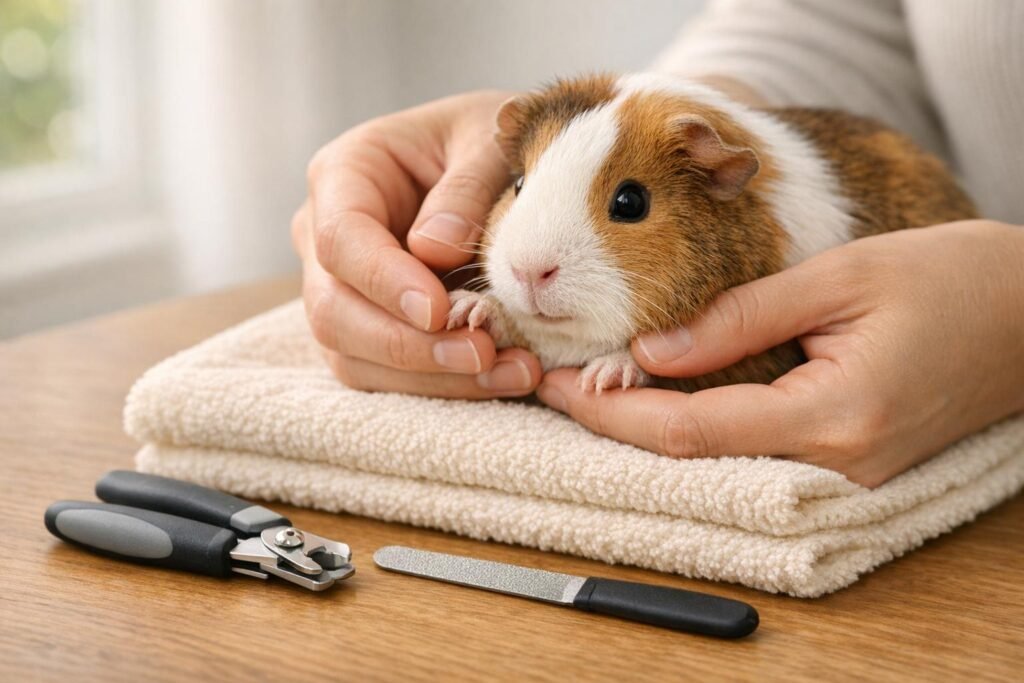
When it comes to trimming rodent nails, you have two primary options: clippers and files. Each tool has its strengths and weaknesses, and the best choice depends on your pet’s needs, nail condition, and your comfort level.
- Clippers: Fast and effective for clear nails, but they risk cutting the quick (the sensitive blood vessel inside the nail). Scissor-style clippers are ideal for small rodents like hamsters and rats, while guillotine-style clippers offer precision for thicker nails. Clippers are best for pets that can sit still briefly.
- Files: Safer and gentler, as they gradually sand down nails, reducing the chance of injury. Manual files like emery boards are great for smoothing sharp edges, while rough surfaces in cages (like ceramic tiles) can passively file nails over time. However, filing takes longer and may require frequent sessions.
Quick Tip: If you’re nervous about trimming, start with a file to avoid cutting the quick. For thick nails, consider combining both tools – clip first, then file to smooth edges.
| Tool | Pros | Cons | Best For |
|---|---|---|---|
| Clippers | Fast, precise, quiet | Risk of cutting quick, sharp edges | Quick trims, clear nails |
| Files | Gentle, safe, smooth finish | Time-intensive, less effective on thick nails | Nervous pets, dark nails |
For safe grooming, always work in a well-lit area, handle your pet gently, and have styptic powder ready for accidents. Regular trims every 2–4 weeks prevent overgrown nails that can cause discomfort or injury. Choose the method that works best for you and your rodent’s comfort.
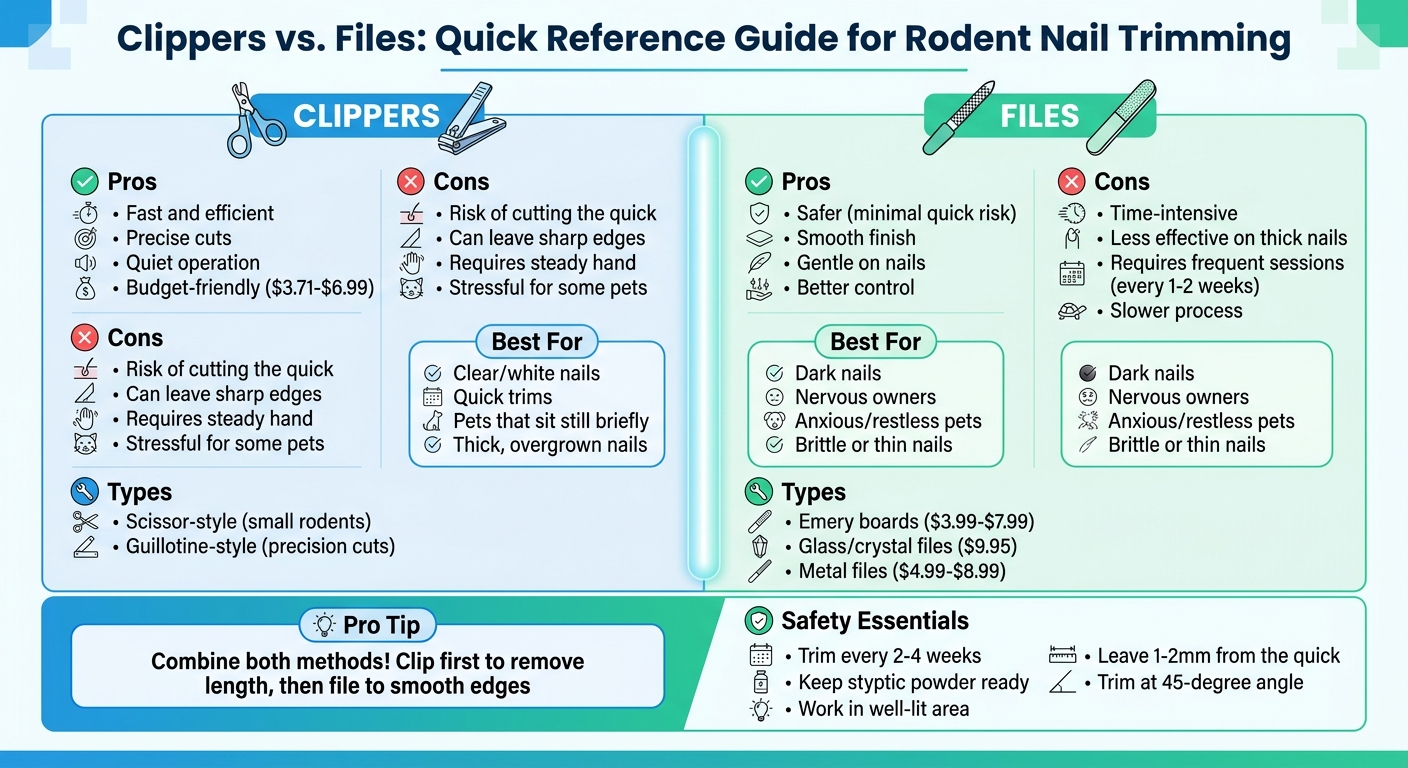
Clippers vs Files for Rodent Nail Trimming Comparison Chart
A Different Way To Clip Rat Nails – Easier and Less Stressful
sbb-itb-e212914
Using Clippers for Rodent Nails
Clippers are a popular choice for trimming rodent nails because they work quickly and quietly. This makes them perfect for pets that tend to squirm or lose patience during grooming. Plus, their silent operation is a big advantage for sound-sensitive animals.
The secret to effective nail trimming lies in using sharp, appropriately sized clippers. As Amy Shojai, a certified cat and dog behavior consultant, advises:
"Choose a convenient and SHARP clipper for the best results."
Using dull blades can crush or splinter the nail instead of cutting it cleanly, which can cause discomfort or even injury. Below, we’ll explore the different types of clippers available.
Types of Clippers
Scissor-style clippers are a great option for small pets like hamsters and rats. They provide excellent visibility and control, making them especially helpful for trimming thick nails. These clippers are often the easiest for beginners to use. A good example is the Pet Republique Professional Nail Clippers, priced at about $6.99, which boasts a 9.6/10 rating thanks to its comfortable, non-slip grip.
Guillotine-style clippers have a small opening for the nail, with a blade that slides across to make a precise cut. According to Liam Carter, an author and reviewer:
"Guillotine-style clippers are generally preferred over scissor-style ones because they provide a more precise cut and reduce the risk of splitting the nail."
However, they can be tricky to use on restless pets and may crush the nail if the blade isn’t sharp.
Plier-style clippers are designed for larger animals, so they’re too bulky for rodents. Their size makes it hard to maneuver around tiny paws. Similarly, human nail clippers aren’t ideal for rodents because they’re made for flat nails and can crush the curved shape of a rodent’s nail instead of cutting it cleanly.
Each type of clipper has its pros and cons, so choosing the right one depends on your pet’s size, nail thickness, and behavior during grooming.
Advantages of Clippers
The right clippers can make grooming safer and more efficient. Clippers are fast, removing nail length in a single snip, which is perfect for pets that won’t sit still for long. They’re also lightweight, portable, and budget-friendly. For instance, the Kaytee Pro-Nail Trimmer is an affordable option that’s easy to find. High-quality clippers provide clean cuts, even on thick nails, and can help keep your pet calm by making the process quicker and less stressful.
Disadvantages of Clippers
One of the biggest risks when using clippers is accidentally cutting the quick – the sensitive part of the nail that contains blood vessels and nerves. This can cause significant bleeding and pain. Jessica Peri highlights this concern:
"Cutting into the quick causes the nail to bleed excessively, and this can be traumatizing to both you and your pet."
Handling clippers also requires care and precision. Rodents may twist or kick during trimming, which can lead to injuries like torn nails or, in severe cases, spinal damage. The process can be stressful for the pet, especially if it’s not used to having its paws touched. To prepare for accidents, keep styptic powder, cornstarch, or flour nearby to stop bleeding if the quick is accidentally cut.
Using Files for Rodent Nails
If you’re a rodent owner hesitant about using clippers, nail files might be the solution you’re looking for. Unlike clippers, which cut through the nail in one go, files work by gently removing thin layers of nail material. This gradual process smooths and shortens the nail without the risk of accidental cuts. It’s a great option for owners who are nervous about clipping or for rodents that struggle to stay still during grooming.
There’s also a hands-off approach to filing. By adding rough surfaces – like bricks, lava ledges, or ceramic tiles – inside your rodent’s cage, you create passive filing stations. Place these surfaces under water bottles or food dishes, and as your pet walks over them, their nails naturally wear down. This method requires no direct handling, making it stress-free for both you and your pet.
Types of Files
Emery boards are a popular choice for small rodents. These flexible, disposable tools are made of cardboard with abrasive paper on both sides. A 10-pack typically costs about $3.99, while a 15-piece kit runs around $7.99. They’re not sterilizable, but their flexibility makes them gentle on tiny paws. For rodent nails, opt for a grit level between 180 and 240 – anything coarser is too harsh and designed for artificial nails, not natural ones.
Glass or crystal files are another option. Their finely sanded surface seals the keratin layers of the nail, reducing the risk of splitting or peeling. These files are durable, easy to sanitize with soap, water, or isopropyl alcohol, and gentler than other types. A high-quality glass file with a protective case costs around $9.95. However, they can be fragile, so dropping one on a hard surface might mean replacing it.
Metal files, made from stainless steel or corundum-coated metal, are known for their durability and ease of cleaning. Prices range from $4.99 for basic models to $8.99 for professional-grade options. However, they can be too abrasive for delicate rodent nails, sometimes causing splintering or chipping. Buffing blocks, which offer multiple grits in one tool, are generally too bulky to use effectively on small paws.
Whether you prefer manual filing or passive filing through rough surfaces, both methods can help keep your rodent’s nails at a manageable length. Each type of file has its own strengths, making it easier to find one that suits your pet’s needs.
Advantages of Files
Using a file greatly reduces the chance of cutting into the quick, the sensitive part of the nail, while also smoothing sharp edges that might snag on bedding or skin. For restless rodents, a soft emery board can make grooming less stressful. Unlike clippers, which can create a pinching sensation, filing is gentler and allows for more control. You can focus on one or two nails at a time, making it easier for anxious pets to tolerate the process. Plus, it’s an effective way to refine hooked tips that could get caught on fabrics or carpets.
Disadvantages of Files
The downside? Filing takes time. It’s a slower process compared to the quick, single motion of clippers. As Caleb Foster notes:
"Filing or using a grinder is a viable alternative, as it is often less stressful for the dog and may feel better. It also eliminates the pinching sensation associated with clippers."
While this applies to dogs, the principle holds true for rodents as well. However, filing is less effective on thick nails, particularly in older rodents whose nails have hardened. You’ll also need to file more frequently – sometimes every one to two weeks – to maintain proper nail length. For thicker nails, motorized grinders can speed up the process, but their noise and vibration require training to help your pet adjust.
Clippers vs. Files Comparison
Clippers work by cutting the nail in a single snip, while files gradually sand away thin layers of the nail surface. This fundamental difference affects both the safety and the time required for grooming. Filing offers greater precision, as it removes tiny layers and allows you to stop before reaching the quick – the sensitive core of blood vessels and nerves within the nail. For pets with dark-colored nails, where the quick is harder to see, using a file makes it easier to trim cautiously without causing injury.
Clippers can sometimes leave rough edges and carry the risk of cutting into the quick, whereas files and grinders provide a smoother finish but take more time. These distinctions also influence how your pet experiences grooming. Clippers create a sudden "snap" sensation that might startle smaller animals, while motorized grinders produce noise and vibrations, and manual files involve prolonged friction that can feel unusual. For pets that are sensitive to noise, manual tools like clippers or files may be a better option. Both methods focus on keeping nails at a healthy length while reducing the risk of discomfort or injury, aligning with the safe grooming principles discussed earlier.
Comparison Table
| Tool Type | Pros | Cons | Best Use Cases | Safety Tips |
|---|---|---|---|---|
| Guillotine Clippers | Quick and efficient cuts; saves time | Risk of cutting the quick; sharp edges | Thick nails on larger pets; visible quick | Use LED light models (around $20.99) for better visibility; keep styptic powder nearby |
| Scissor Clippers | Offers better control; quiet operation | Needs sharp blades for effectiveness | Small to medium nails; noise-sensitive pets | Trim in thin layers and watch for a dark oval in the nail center |
| Emery Boards | Gentle and precise; very safe to use | Time-intensive; not ideal for thick nails | Smoothing sharp edges; for cautious owners | – |
| Motorized Grinders | Smooth, rounded finish; ideal for dark nails | Can be noisy; risks heat buildup | Thick nails; creating a polished finish | Limit use to 1–2 second bursts to avoid overheating |
How to Trim Rodent Nails Safely
Before you get started, it’s important to prepare both your rodent and your tools. Spend about a week handling your pet’s paws daily. This helps reduce their anxiety when it’s time for nail trimming. Make sure you’re working in a well-lit area, and keep styptic powder, cornstarch, or white flour close by in case of any accidental nicks. Sanitize your clippers with rubbing alcohol beforehand to ensure everything is clean and ready to go.
Timing is key. Aim to trim your rodent’s nails when they’re drowsy – perhaps after a meal. You can wrap them snugly in a towel, leaving one paw exposed at a time, or ask someone to help hold them steady. As Jessica Peri wisely points out:
"A sleepy rat is much easier to handle than an awake and energetic rat!"
If your pet starts to twist, squeak loudly, or show signs of distress like heavy breathing, stop immediately to avoid causing unnecessary stress.
Choosing Your Method: Clipping or Filing
There are two main ways to trim your rodent’s nails: clipping or filing. Each has its own advantages, so choose the one that feels best for you and your pet.
Clipping
For a quick trim, gently hold one of your rodent’s toes between your thumb and index finger. Look for the pinkish quick inside the nail – it’s the sensitive part you want to avoid. For darker nails, use extra light to help guide you. Hold the clippers at a 45-degree angle and trim just the sharp hook of the nail, leaving about 1–2 mm of space from the quick. If you accidentally cut too close and bleeding occurs, apply styptic powder with light pressure for 1–2 minutes to stop it. You’ll know if you’ve hit the quick because your pet will react immediately.
Filing
If you’re nervous about clipping or your pet is particularly squirmy, filing can be a safer option. Use the same restraint methods, and gently file the tip of each nail with a soft emery board. This method removes less material, so it’s a slower process and may need to be done weekly. However, it carries almost no risk of hitting the quick, making it a great choice for nervous owners or pets that don’t sit still.
Positive Reinforcement Matters
Once the session is over, reward your rodent with a favorite treat and plenty of praise. This helps them associate nail trimming with positive experiences. If your pet seems particularly stressed, consider trimming just 1–3 nails per session to keep things low-pressure and manageable for both of you.
Choosing Between Clippers and Files
When it comes to safe nail trimming, deciding between clippers and files depends on several factors: your pet’s nail color, nail condition, temperament, and even your own comfort with each tool.
If your rodent has clear or white nails where the pink quick is easy to see, clippers are a quick and effective option. However, for pets with dark nails, where the quick is harder to spot due to pigmentation, filing is often the safer choice. Filing allows you to gradually remove small amounts of nail, reducing the risk of accidentally cutting into the quick.
The condition of your rodent’s nails also plays a role. If their nails are brittle, thin, or prone to splitting, filing is gentler and can help avoid further damage caused by the pressure of clippers. On the other hand, for thick or overgrown nails, heavy-duty clippers might be more efficient than low-power files. For beginners, filing can feel less intimidating since it removes only a little at a time, minimizing the chance of a big mistake.
Your pet’s temperament is another key consideration. Clippers are quiet and work well for sound-sensitive rodents, while files or grinders may make noise or vibrate, which could require some time for your pet to get used to. Filing also leaves smoother edges, which is helpful for pets that tend to scratch. That said, clipping is much faster, making it a good option for wiggly rodents with limited patience. Filing, although slower, offers more precision and control.
Many experienced pet owners use a combination of both tools – clippers to trim excess length and a file to smooth out the edges. For smaller rodents like mice, hamsters, and rats, small human or baby nail clippers work well. Larger rodents, such as guinea pigs and rabbits, often have thicker nails that are better suited to scissor-style clippers or grinders.
Required Supplies and Safety Tips
When it comes to nail trimming, having the right tools and following essential safety steps can make the process much easier and less stressful – for both you and your pet.
Start by gathering the necessary supplies. You’ll need rodent clippers that are the right size for your pet. Guillotine-style or scissor-style clippers work well, and an example is the Kaytee Pro-Nail Trimmer, which costs around $3.71–$4.89. For smoothing edges or thicker nails, a soft emery board, nail file, or even a Dremel with a small sanding drum can be useful.
Accidents can happen, so it’s important to have styptic powder on hand to quickly stop any bleeding if you accidentally cut the quick. Apply it with a cotton swab and press gently for 30–60 seconds. If you don’t have styptic powder, cornstarch or white flour can work as temporary alternatives, though they aren’t as effective.
Good lighting is crucial for spotting the quick, especially if your pet’s nails are dark. Use a hands-free LED headlamp or shine a small flashlight behind the nail for better visibility. For very small nails, a magnifying glass can also be helpful.
Proper handling is another key factor in ensuring a safe trimming session. Hold each toe firmly between your thumb and pointer finger to gently splay the toes apart. This gives you a better view and a steadier grip. If possible, enlist a helper – one person can restrain your pet while the other trims the nails. Timing is also important. Trim your pet’s nails when they’re calm, such as after a meal, and keep some high-value treats like seeds or fruit handy to distract and reward them during the process.
When trimming, leave about 1–2 mm of clear nail in front of the quick to avoid cutting too close. Cut at a 45-degree angle to mimic the nail’s natural shape and wear. If you do accidentally cut the quick and bleeding doesn’t stop after 5–10 minutes of applying styptic powder and pressure, contact your veterinarian immediately.
With the right supplies and these safety tips, you can confidently and carefully trim your pet’s nails.
Conclusion
Choosing the best tool for rodent nail care means finding the right balance between speed and safety. Clippers offer a quick solution, cutting nails instantly with one snip – perfect for clear nails – but there’s a risk of accidentally cutting the quick or leaving rough edges. On the other hand, files and grinders work more slowly, using abrasion to trim nails. This method gives you better control and reduces the chance of cutting too deep, though it requires more time and patience. As Belle & Cooper explain, grinders are gentler because they rely on gradual abrasion rather than the sharp action of clippers.
Many pet owners find success by combining the two methods: using clippers for the initial trim and then smoothing out edges with a file. This approach ensures grooming is both efficient and precise. The key is using tools that are the right size and sharp enough to avoid crushing or splintering the nail, which can cause your pet unnecessary pain. Whether you prefer clippers, files, or a mix of both, proper nail care is essential for keeping your rodent comfortable, healthy, and stress-free.
FAQs
How do I find the quick in dark rodent nails?
To trim dark rodent nails without harming the quick, take it slow and remove tiny amounts at a time. Since the quick isn’t visible, pay attention to any dark dots or subtle changes in the nail’s shape as you cut. This careful method minimizes the risk of hitting the quick, helping you avoid bleeding or injury.
What if my rodent won’t stay still during trimming?
If your rodent keeps squirming, try gentle restraint methods such as the Treat Stretch, Cup Hold, Towel Burrito, or Clear Container Assist to reduce stress and limit movement. Set up your trimming area in advance, handle your rodent frequently on days when trimming isn’t needed, and aim to trim when your pet is relaxed. If your pet continues to resist, work on gradually getting them used to being handled, or reach out to a veterinarian for guidance to keep the process safe.
When should I use clippers and then file afterward?
Use nail clippers to carefully trim your rodent’s nails if they become too long or sharp, as this can lead to discomfort or even injuries. After trimming, use a nail file to smooth out any rough edges. This combination of clipping and filing works well for thick or uneven nails, keeping them rounded and less likely to cause scratches or harm to your pet or anyone handling them.