Poor ventilation in rodent cages can quickly lead to serious health problems for your pets. Without proper airflow, harmful gases like ammonia and carbon dioxide accumulate, oxygen levels drop, and temperature and humidity rise, creating a dangerous environment. Here’s what you need to know:
- Ammonia: Forms from urine breakdown in bedding. Levels above 50 ppm harm respiratory health, causing lung damage and infections.
- Carbon Dioxide: Builds up in poorly ventilated spaces, leading to breathing difficulties and stress for your pets.
- Humidity and Heat: Trapped moisture increases bacterial growth, speeds up ammonia production, and raises cage temperatures.
- Allergens: Dust, dander, and urinary proteins accumulate, worsening respiratory issues.
To keep your rodents healthy, aim for 60 air changes per hour (ACH) in ventilated cages or 10–15 ACH at the room level. Replace bedding regularly, monitor gas levels, and consider using individually ventilated cage (IVC) systems for better air quality. Watch for warning signs like strong odors, damp bedding, lethargy, or breathing difficulties, and act promptly to improve ventilation.
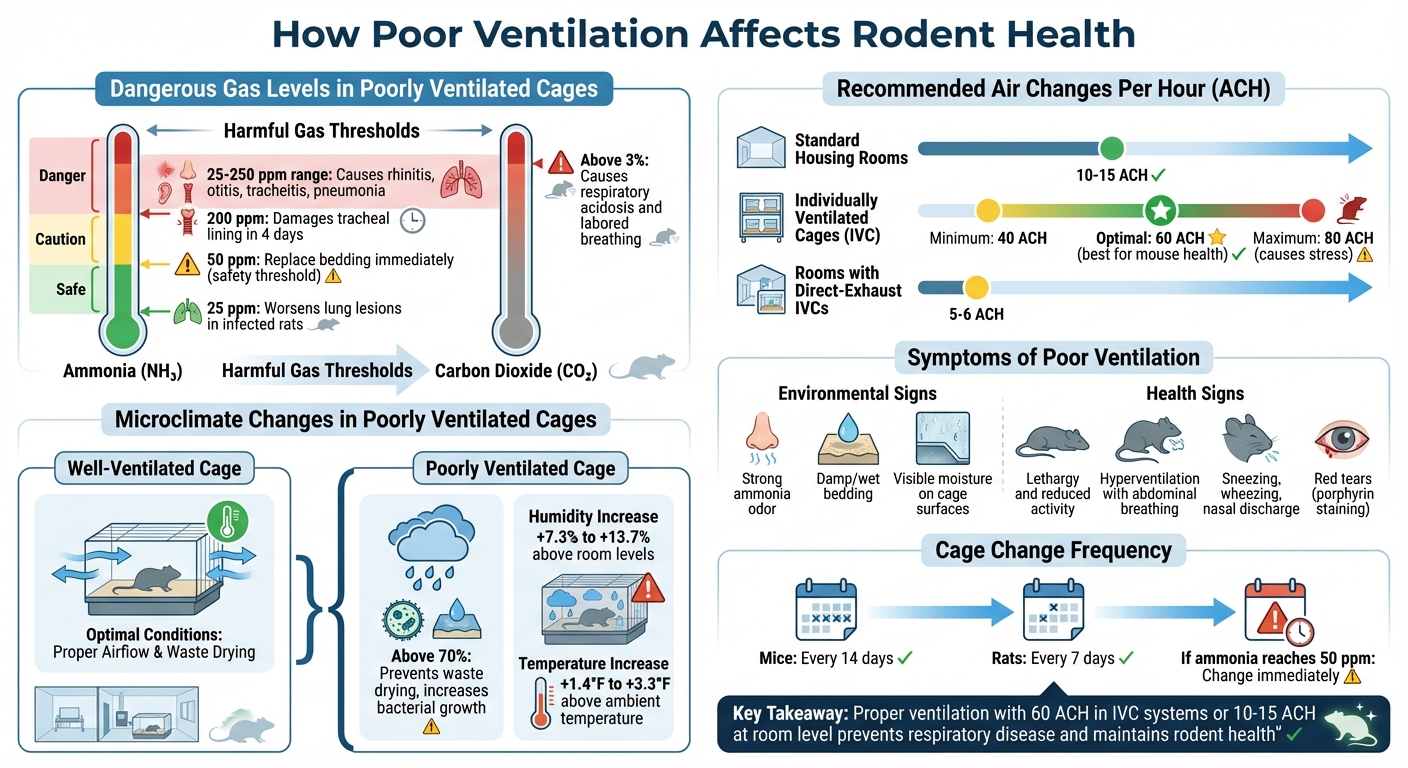
Rodent Cage Ventilation Standards and Health Thresholds
Health Problems Caused by Poor Ventilation
Buildup of Harmful Gases
When ventilation is lacking, the air quality inside your pet’s cage can deteriorate quickly, creating serious health risks. Without proper airflow, ammonia and carbon dioxide levels rise rapidly. Ammonia forms when bacteria break down urea in urine, and even at concentrations as low as 25 ppm, it can worsen lung lesions in infected rats. Higher levels – around 200 ± 50 ppm – can damage the tracheal lining within just four days and disrupt the mucociliary escalator, the natural system rodents rely on to clear dust and pathogens from their lungs .
"The metaplastic and ciliary inhibiting effects of ammonia can extend an innocuous upper respiratory infection into a bronchopneumonia",
notes Dr. Melissa A. Kling.
Studies have linked ammonia levels between 25 and 250 ppm to rhinitis, otitis, tracheitis, and pneumonia in rats.
On the other hand, carbon dioxide buildup poses its own set of challenges. When CO₂ levels exceed 3%, rodents may develop respiratory acidosis, which forces them to breathe harder, often with noticeable abdominal effort. Unlike humans, who can leave poorly ventilated areas, pets remain confined to their cages, facing prolonged exposure to these harmful gases. Poor ventilation compounds the issue by also affecting temperature and humidity, further stressing your pet’s health.
Temperature and Humidity Problems
Inadequate airflow doesn’t just allow harmful gases to accumulate – it also traps heat and moisture inside the cage. Research indicates that relative humidity inside cages can be 7.3% to 13.7% higher than in the surrounding room. When humidity rises above 70%, waste doesn’t dry properly, which encourages bacterial growth and increases ammonia production .
Trapped moisture also raises cage temperatures by 1.4°F–3.3°F compared to the ambient environment . High humidity levels create the perfect conditions for mold and bacteria to thrive, further endangering your pet’s respiratory health.
Higher Risk of Allergens and Disease
Stagnant air does more than trap gases and moisture – it also allows allergens to accumulate. Dust, dander, and urinary proteins can build up in much higher concentrations than in the surrounding environment. These particles can irritate the respiratory system, and finer particles that reach deep into the lungs can cause lasting damage.
The combined effects of ammonia exposure and allergen buildup make respiratory infections more likely. Ammonia weakens the respiratory lining, making it easier for pathogens like Mycoplasma pulmonis to infect your pet. Matthew D. Rosenbaum from East Carolina University‘s Department of Comparative Medicine explains:
"High humidity levels prevent fecal and urinary desiccation and provide the optimal setting for bacterial propagation and subsequent ammonia production"
.
Many of these health issues are subclinical, meaning the damage might not be immediately visible but can still have a significant impact on your pet’s overall health.
sbb-itb-e212914
Ventilation Standards for Rodent Cages
Air Changes Per Hour (ACH) Requirements
Proper ventilation is essential to prevent harmful gas buildup in rodent cages. One way to measure ventilation is through air changes per hour (ACH), which calculates how often air in a space is replaced hourly. For standard animal housing rooms, experts recommend an ACH rate between 10 and 15.
If you’re using individually ventilated cages (IVCs), the ventilation needs are much higher. These systems require 40–80 ACH within the cage itself. Research suggests that maintaining 60 ACH creates the best conditions for mouse health. However, exceeding this range – such as reaching 80 ACH – can cause more harm than good. High rates like these have been linked to increased stress hormones (corticosterone and epinephrine) and a drop in immune cell levels.
For IVCs equipped with direct-exhaust systems, the room’s ventilation can be reduced to 5–6 ACH without compromising air quality.
Failing to meet these ACH standards can lead to noticeable warning signs.
Warning Signs of Poor Ventilation
A strong ammonia smell is a clear indicator of inadequate ventilation. Bedding should be replaced before ammonia levels hit 50 ppm to avoid respiratory issues.
Other warning signs include visible moisture on cage surfaces and changes in your pet’s behavior. Watch for lethargy, reduced activity, or hyperventilation with noticeable abdominal breathing – these can signal high carbon dioxide or low oxygen levels. Additionally, respiratory symptoms like sneezing, wheezing, or nasal discharge are red flags that require immediate attention.
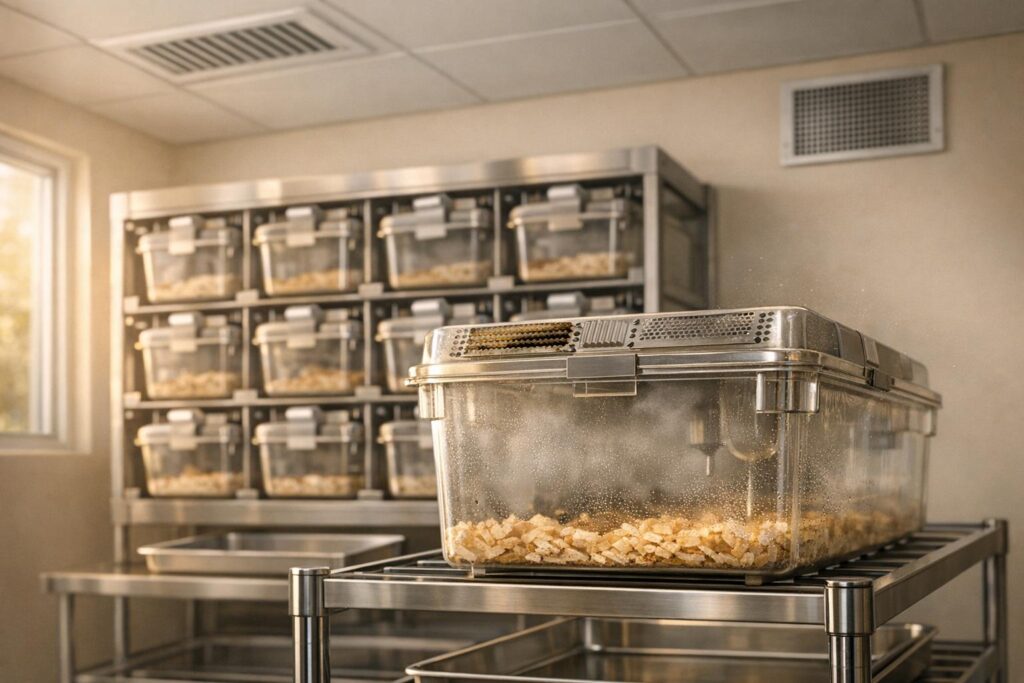
Inside My ASF Rodent Facility | Automated Water, Ventilation & Colony Setups
How to Improve Ventilation in Rodent Cages
Creating a safer and healthier environment for rodents starts with addressing ventilation issues. Here are practical solutions to enhance air quality in rodent cages.
Using Individually Ventilated Cage (IVC) Systems
IVC systems provide HEPA-filtered air at 30–120 air changes per hour (ACH), helping to reduce ammonia and CO₂ levels, stabilize oxygen, and lower humidity. Each cage functions as its own biocontainment zone, limiting the spread of diseases.
One standout feature of IVC systems is their ability to handle contaminated air effectively. Direct-exhaust IVCs remove waste gases directly from the cage and channel them into the building’s exhaust system. This setup can significantly reduce allergens and ammonia in the surrounding room air – studies show that mouse allergens in the air can drop by up to 50 times when using IVCs.
"A particular benefit of IVC is improved air quality within the cage when compared with static microisolator cages, including lower ammonia, lower CO₂, higher O₂, lower humidity, and drier bedding."
- Roger S. Geertsema, University Laboratory Animal Resources
When choosing an IVC system, go for laminar airflow models rather than forced-air ones. Laminar airflow moves air gently from front to back through large filter openings, while forced-air systems create drafts that rodents can sense, especially at speeds over 39 feet per minute. To ensure even airflow, position supply and exhaust ports on opposite sides of the cage.
Improving cage ventilation is just one part of the equation – enhancing room-level airflow is also critical.
Room-Level Ventilation Strategies
Optimizing room ventilation complements cage-level systems and further improves air quality. Direct-exhaust IVC systems allow for reduced room ventilation rates – down to 5–6 ACH – without sacrificing air quality. A 16-week study at the University of California, Irvine, led by Roger S. Geertsema and Claire E. Lindsell, confirmed that air quality remained acceptable for both animals and humans at these lower rates.
"Air quality in the room and in the cages were acceptable with room ventilation rates of 5 to 6 ACH in rodent rooms that use direct-exhaust IVC systems."
- Roger S. Geertsema, University Laboratory Animal Resources
Adding pre-filters can cut particulate counts significantly (from approximately 950,284 to 365,285 per cubic foot). Maintaining temperature and humidity below critical levels also helps limit ammonia production.
To sustain these improvements, regular maintenance is essential.
Maintenance Tips for Better Ventilation
Proper upkeep plays a vital role in preventing ammonia buildup and ensuring effective cage ventilation. Stick to the following maintenance schedule:
- Change mouse cages every 14 days and rat cages every 7 days.
- Use handheld photoionization detectors or Dräger tubes to monitor ammonia levels. If readings hit 50 ppm, replace the cage immediately.
- Replace IVC HEPA filters as per manufacturer guidelines to maintain steady airflow.
- Ensure cages are docked correctly on the rack; improper docking can cause CO₂ levels to rise and oxygen levels to drop within hours.
- Check that exhaust airflow is consistent across the rack to avoid localized gas accumulation.
When changing cages, use a ventilated station to minimize allergen release. If your facility uses automated monitoring systems, recalibrate or replace sensors for TVOC, CO₂, and particulates every six months to ensure accuracy. For housing multiple animals, opt for larger cages (Type III) instead of smaller ones (Type II). The extra headspace helps keep ammonia levels lower, even with similar stocking densities.
Conclusion
Good ventilation is crucial for keeping rodents healthy and comfortable. Without proper airflow, harmful gases can build up quickly, causing respiratory problems and weakening your pet’s immune system over time.
To manage this, aim for about 60 air changes per hour (ACH) in IVC systems or ensure room ventilation reaches 10–15 ACH for rats and mice. This helps clear out harmful gases while avoiding drafts that could stress your pets . Using larger cages, like Type III, can also reduce ammonia buildup compared to smaller ones, such as Type II.
"Cage ventilation at 60 ACH provided an optimum cage microenvironment for mouse health and welfare."
- Hongyan Chen, Harbin Veterinary Research Institute
Proper ventilation does more than prevent gas accumulation – it also allows for early detection of health issues. Be alert for symptoms like abdominal breathing, hyperventilation, or "red tears." Keep ammonia levels below 50 ppm by cleaning regularly, including full bedding changes every 7–14 days. Rats, in particular, may need more frequent cleaning. If you notice strong odors, damp bedding, or signs of respiratory distress, check and adjust your ventilation immediately.
Consistent airflow and careful monitoring are key. By following these guidelines and addressing problems quickly, you can create a safer space for your rodent, protecting them from avoidable respiratory issues and supporting their overall health.
FAQs
How can I tell if my cage airflow is too low?
Low cage airflow can show up in several ways, like a noticeable increase in dust, stronger odors, or more allergens in the air. You might also see debris piling up around vents, which often points to blocked or poor ventilation. Tackling these issues quickly is important to keep your rodents’ environment clean and healthy.
What’s the safest way to boost ventilation without causing drafts?
Improving ventilation without causing drafts requires a delicate balance. To enhance air quality while maintaining comfort, consider using adjustable ventilation systems that adapt to changing environmental conditions. These systems can ensure airflow aligns with real-time needs, creating a healthier environment.
For example, maintaining an optimal cage ventilation rate of about 60 air changes per hour (ACH) for mice can promote their well-being. Ventilation rates higher than this, such as 80 ACH, may lead to discomfort and stress. By sticking to appropriate ventilation levels, you can support the health of rodents while keeping them comfortable.
Do different rodent species need different ventilation and cleaning schedules?
Different rodent species often need tailored ventilation and cleaning routines based on their cage type and the conditions of their microenvironment. Studies indicate that longer intervals between cleanings can still be safe, particularly in individually ventilated cages, provided that proper health standards are upheld.