
When kids ask for a pet rabbit, it’s easy to imagine a cuddly, low-maintenance companion. But caring for rabbits is much more demanding than many expect. They require daily care, proper handling, and a long-term commitment, often living 8–12 years. While rabbits can teach kids responsibility and empathy, they also come with challenges like fragility, high maintenance needs, and specialized care costs.
Key Takeaways:
- Pros: Rabbits are quiet, affectionate, suitable for small spaces, and can teach kids valuable life skills.
- Cons: They’re fragile, need daily care, require significant time and money, and can be stressed by chaotic environments.
- Cost: Expect to spend $300+ on setup, $150/month for upkeep, and higher vet costs due to their classification as exotic pets.
For families prepared to meet their needs, rabbits can be rewarding pets. But they’re not the “easy” choice many assume. Think carefully before adopting, and consider fostering first to see if a rabbit fits your lifestyle.
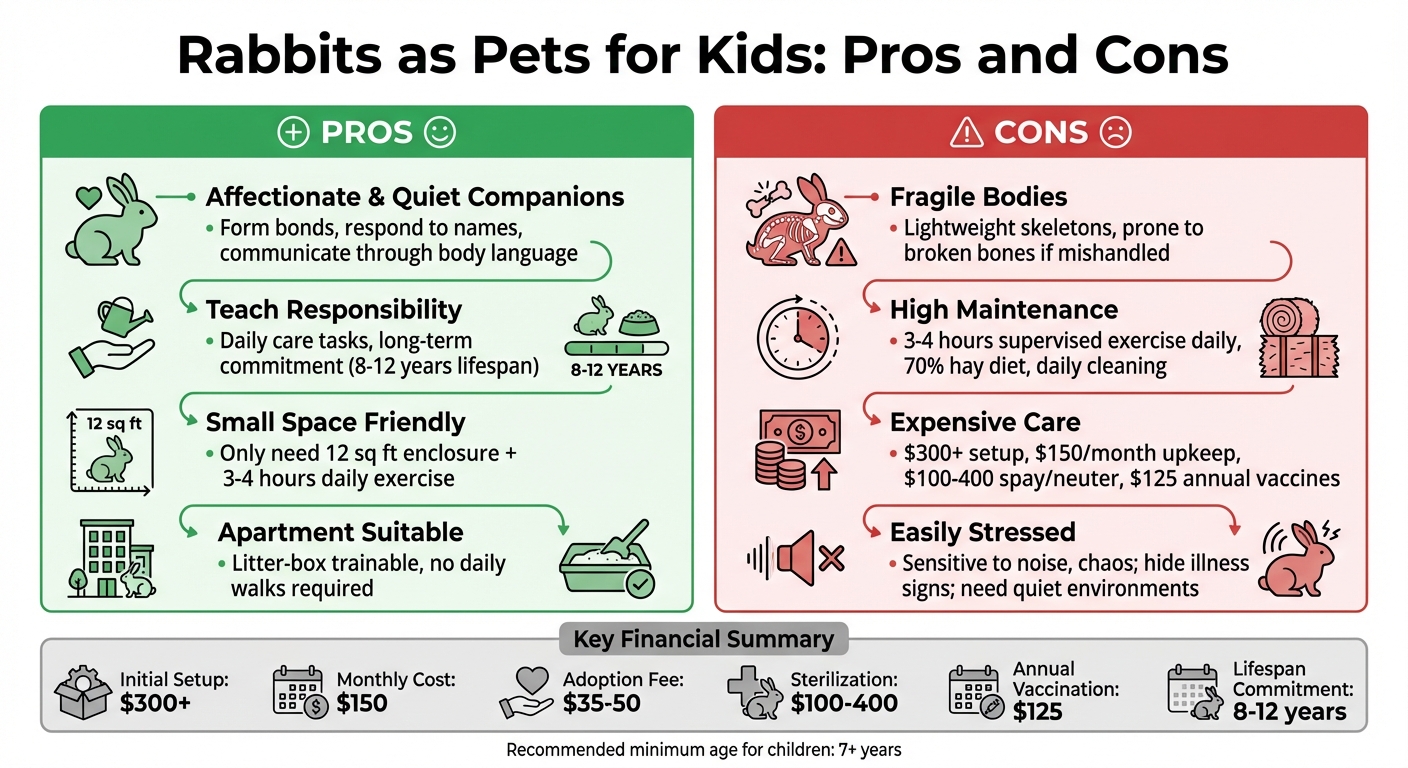
Pros and Cons of Rabbits as Pets for Kids
Are Rabbits Good Pets for Children? | Pet Rabbits
sbb-itb-e212914
Pros of Rabbits as Pets for Kids
Rabbits can be wonderful pets for families that are prepared to meet their care requirements. With the right environment and attention, these animals can become delightful companions for children.
Affectionate and Quiet Companions
Rabbits form strong bonds with their caregivers. They can learn to respond to their names and even perform simple tricks. Unlike smaller pets like hamsters or mice, rabbits show affection in subtle yet meaningful ways. They may nudge with their noses, lick your hand as a sign of trust, or relax beside you when they feel safe.
"Rabbits show affection in more subtle ways – nudging your hand, flopping down beside you, or following you around when they trust you."
- Angela Vuckovic, Pet Author
Their quiet nature makes them ideal for indoor living. Instead of barking or meowing, rabbits communicate through body language, soft grunts, or gentle thumps. A truly happy rabbit might even perform a "binky" – a joyful leap and twist in mid-air. To make them feel secure, children should interact with rabbits at ground level, where they are most comfortable.
Teaching Responsibility and Empathy
Owning a rabbit offers children a hands-on lesson in responsibility. Daily tasks like providing fresh hay and water, measuring food, and cleaning litter boxes teach kids about commitment and care. Since rabbits are naturally cautious and often prefer not to be held, children also learn to respect the animal’s boundaries – a valuable lesson in patience and empathy.
Rabbits live for 8 to 12 years, which helps children understand that having a pet is a long-term responsibility, not a temporary hobby. Marinell Harriman, author of Importance of Permanence, highlights this point:
"It is not easy to manage young humans and animals, but when parents find solutions, rather than dispose of an animal for convenience sake, an important concept is communicated to the child. This is alive. This is valuable. You don’t throw it away."
These qualities make rabbits a fitting choice for families looking to instill life lessons in their children.
Suitable for Small Living Spaces
Rabbits adapt well to indoor living, making them a great option for apartments or smaller homes. They only require a 12-square-foot enclosure and about 3-4 hours of supervised exercise daily. Many rabbits can also be litter-box trained, which helps maintain cleanliness in tight spaces.
Their suitability for compact homes often aligns with rental policies. Unlike dogs, rabbits don’t need daily walks, making them a low-maintenance choice for urban families. However, it’s important to rabbit-proof your home by covering electrical cords and protecting furniture from chewing. This ensures a safe environment for both your rabbit and your belongings.
Cons of Rabbits as Pets for Kids
While rabbits can be delightful pets, there are several challenges families should consider before deciding to bring one home.
Delicate Bodies and Handling Risks
Rabbits are physically fragile creatures. Their lightweight skeletons and strong hind legs make them prone to serious injuries, like broken backs, if they aren’t handled correctly . As prey animals, being picked up often triggers a fear response, causing them to struggle, kick, bite, or scratch. In extreme cases, a startled rabbit could even die from shock. Because young children may lack the precision and restraint needed to handle rabbits safely, experts suggest waiting until kids are at least seven years old before allowing them to closely interact with these pets.
Jess Faraday, a pet care expert, highlights this fragility:
"Rabbits are surprisingly fragile. Much more so than dogs and cats. If a rabbit is grabbed the wrong way, squeezed too hard or dropped, it often means broken bones. And for a rabbit, broken bones are often the end."
This delicate nature not only impacts how they can be handled but also adds to the overall care and attention they require.
High Maintenance and Time Commitment
Rabbits are often mistaken as "easy" or "starter pets", but their care demands are anything but simple. They require 3–4 hours of supervised exercise every day, a diet consisting mainly of hay (about 70%), with small amounts of pellets and specific fresh greens. Their living areas need daily spot-cleaning, weekly deep cleaning, regular grooming (especially for long-haired breeds), and monthly nail trimming.
The financial aspect is another factor to consider. Setting up an enclosure typically costs at least $100. Spaying or neutering can range from $100 to $400, while annual RHDV2 vaccinations cost around $125. Since rabbits are classified as exotic pets, their veterinary care is often pricier than that for cats or dogs. And if children lose interest in caring for the rabbit after a few weeks, the responsibility usually falls on the parents – for a pet that can live 10–12 years.
Stress and Behavioral Challenges
Rabbits are naturally timid and easily stressed by loud noises, sudden movements, or chaotic environments. Stress can lead to behaviors like grunting, lunging, or nipping. Chronic stress from boredom, lack of space, or inconsistent routines may result in aggression, excessive grooming, or repetitive actions.
The House Rabbit Society explains:
"As prey animals, rabbits instinctually feel frightened when picked up. As a result, they will often kick and struggle, which can result in hurting themselves or even the child holding them."
Rabbits also hide signs of illness as a survival instinct, making it essential to monitor subtle changes in their behavior, appetite, or droppings. Conditions like gastrointestinal stasis can escalate quickly and may be fatal without prompt treatment. Additionally, many rabbits become overstimulated after about two hours of interaction, and noisy, busy environments – like classrooms – can be particularly overwhelming for them.
Solutions to Common Rabbit Ownership Challenges
Owning a rabbit comes with its challenges, but with some preparation and understanding, families can create a safe, enjoyable environment where both kids and rabbits can thrive.
Selecting the Right Rabbit for Your Family
Size and personality are key. Larger breeds like French Lops are often calmer and sturdier, making them a good choice for families with younger children. On the other hand, smaller breeds, such as dwarf rabbits, tend to be more energetic and are better suited for older children who can handle them carefully.
Focus on temperament, not breed. While the American Rabbit Breeder’s Association recognizes 49 different rabbit breeds, a rabbit’s personality matters more than its breed. Look for rabbits described as "outgoing" or "confident." Timid rabbits, as Stacey Paiva from the House Rabbit Network explains, are better suited to quieter households:
"The timid bun does best in a quiet household without young children".
Consider adopting an adult rabbit. Rabbits older than one year often have more predictable and calm personalities compared to younger ones. Rescue organizations are great resources, as their staff can help match a rabbit’s personality with your family’s lifestyle. Always opt for a spayed or neutered rabbit to minimize territorial or aggressive behaviors. When meeting potential pets, visit during early morning or evening hours when rabbits are naturally more active. Lastly, ensure no one in your household is allergic to rabbits or the hay they require.
Once you’ve chosen the right rabbit, teaching children how to interact with their new pet is the next step.
Teaching Children Proper Handling Techniques
Teaching kids how to handle a rabbit properly is crucial for building trust and ensuring everyone’s safety.
Start with ground-level interactions. Encourage children to sit on the floor and allow the rabbit to approach them on its own terms. Adults should handle any lifting or carrying to avoid accidental injury or stress for the rabbit.
Set clear "Bunny Rules." Teach kids to gently pet the rabbit on its head, ears, or upper back using a flat hand to avoid pulling its fur. Explain the importance of giving the rabbit space – if it hops away, it should be left alone. Also, remind children not to touch droppings or litter and to avoid chasing or startling the rabbit with sudden movements.
Learn rabbit body language. Help children recognize signs of happiness, such as soft teeth clicking or playful "binkies" (those adorable mid-air twists). At the same time, teach them to spot signs of stress, like thumping, lunging, or hiding. Supervised interactions allow kids to observe calm and respectful behavior, which they can mimic.
With handling techniques in place, it’s time to create a living space that meets your rabbit’s needs.
Setting Up Appropriate Housing and Exercise Areas
Keep rabbits indoors. Indoor living protects rabbits from predators, harsh weather, and fosters stronger bonds with the family. A single rabbit needs at least 12 square feet of living space, such as a 4′ x 3′ exercise pen. If you choose a cage, it should be no smaller than 2′ x 2′ x 4′. Avoid wire-bottom cages, as they can cause painful foot injuries. Instead, opt for solid surfaces lined with wood or cardboard.
Rabbit-proof your home. Secure electrical wires, cover furniture, and block off hazardous areas. Use carpet scraps or rubber-backed runners in exercise spaces to provide traction for running and jumping.
Create a safe and engaging environment. Designate a "safe zone" in the rabbit’s living area where it can retreat from household activity. Place a litter box in the corner the rabbit naturally chooses for urination – lined with newspaper and timothy hay for easy cleaning. Provide enrichment items like cardboard boxes and chew-safe toys to keep your rabbit mentally stimulated. Rabbits need 3 to 4 hours of supervised exercise outside their enclosure daily, so plan regular playtime in a secure, quiet area free from extreme heat or disturbances.
Conclusion: Making an Informed Decision
Rabbits can be fantastic pets for the right family, but they’re not the low-maintenance "starter pet" they’re often mistaken for. These animals require an 8–12 year commitment, with daily responsibilities like providing hay, fresh vegetables, and 3–4 hours of supervised exercise every day. Carolyn Mixon, a House Rabbit Educator, puts it plainly:
"Rabbits and children make sense when a parent is in charge."
Before bringing a rabbit into your home, it’s essential to assess your family’s lifestyle and readiness for this commitment. Are your children calm and patient enough to handle a prey animal that thrives in a quiet, gentle environment? Are you prepared to take on the role of primary caregiver, as it’s unrealistic to expect a child to manage all the responsibilities? Additionally, make sure your home has the required space and can be adequately bunny-proofed.
Financial readiness is just as important. Rabbit care involves a $35–$50 adoption fee, around $300 for initial setup, $100–$400 for sterilization, and about $150 per month for ongoing supplies. Specialized veterinary care is also a necessity and often costs more than care for cats or dogs.
If you’re unsure about the long-term commitment, consider fostering a rabbit through your local shelter as a trial run. This approach allows your family to experience rabbit care without a permanent commitment. When you’re ready to adopt, look for medium-to-large adult rabbits from rescues. These rabbits often have established personalities, are usually already spayed or neutered, and tend to be more robust than smaller breeds.
FAQs
Is my child old enough for a rabbit?
Deciding whether your child is ready for a rabbit comes down to their ability to treat the animal with care and responsibility. Rabbits are quite fragile, prefer to stay on the ground, and generally dislike being picked up – something younger kids might struggle to understand. Typically, children aged 8 and older are better equipped to handle their care, while younger kids can still enjoy interacting with rabbits but should do so under close adult supervision. Think about your child’s maturity level and how involved you’re willing to be in overseeing the rabbit’s care.
How can I tell if my rabbit is stressed or sick?
Watch out for shifts in your rabbit’s behavior – things like a sudden loss of appetite, unusual tiredness, or changes in how they interact. Physical signs can include discharge from their eyes or nose, the appearance of a noticeable third eyelid, or droppings that look different from normal. Since rabbits are experts at hiding when they’re sick, regular check-ups and quick trips to the vet when something seems off are essential to spotting problems early and keeping them in good health.
Should we adopt, buy, or foster first?
Deciding whether to adopt, buy, or foster a rabbit largely comes down to how prepared you are to handle the responsibilities of rabbit care. Adopting means giving a home to a rabbit that needs one, often from a shelter or rescue organization. Fostering, on the other hand, provides a temporary home and lets you gauge your readiness for long-term care. If you choose to buy, it’s crucial to do thorough research to ensure you can meet the rabbit’s needs. Many experts suggest starting with fostering or adopting, as it helps you gain valuable experience and determine if your household is ready for the commitment.